
UFO Timeline

UFO Timeline

Overview of the UFO Phenomenon

5.0
9
Visits
Visit

Available Pages

Version History

Design Analysis

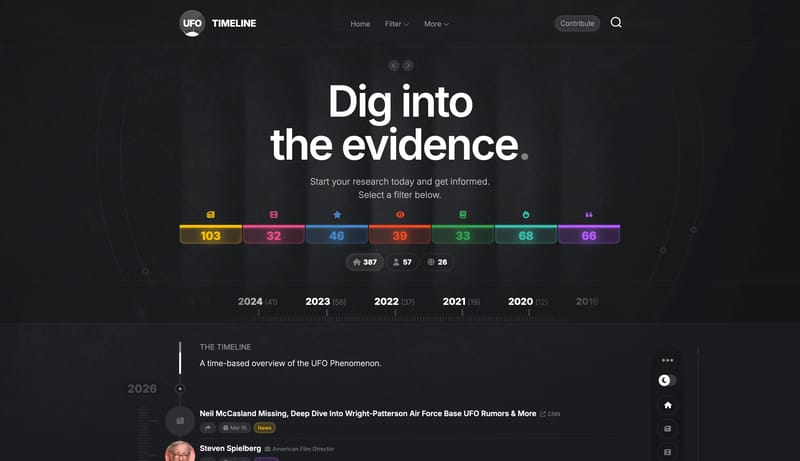
UFO Timeline Home design analysis

--- version: alpha name: Dark Evidence Timeline description: A dark investigative archive design language with grainy black surfaces, giant white headlines, neon category counters, year rails, vertical event timelines, f...

Overview

This design language is for dense research archives and event chronologies. It uses a grainy charcoal shell, huge white entry headlines, bright category counters, a horizontal year ruler, a vertical event timeline, and a docked utility rail for long browsing sessions. The interface should feel documentary and evidence-led. Color is functional: it marks categories, active filters, statistics, and timeline tags.
Colors

Use 191A1E as the primary page shell. Layer 222328 for cards, floating controls, accordions, and translucent panels. Use 2C2D31 for ruler ticks, timeline tracks, and dividers. Use white for headings and event titles. Use muted gray text for body copy and secondary navigation.

Typography

Use Inter or a similar compact grotesk. Hero type can be very large, around 92px / 92px, centered, and white. Event titles are much smaller, around 18px / 24px, but bold enough to scan in dense lists. Body copy should be light-weight and muted, around 17px / 25.5px. Use uppercase labels for category headings and section identifiers.

Layout

Use a dark fixed-feeling shell from top to bottom. Entry pages can start with a centered hero and category counters, then drop into a year ruler and continuous vertical timeline. Timeline pages should be dense. Group events by year, keep nodes in a left gutter, and separate rows with faint lines instead of cards. Index pages can switch to a card grid with portraits and short metadata.

SpacePlay/PauseSeek 1sShiftSeek 10s