Overview
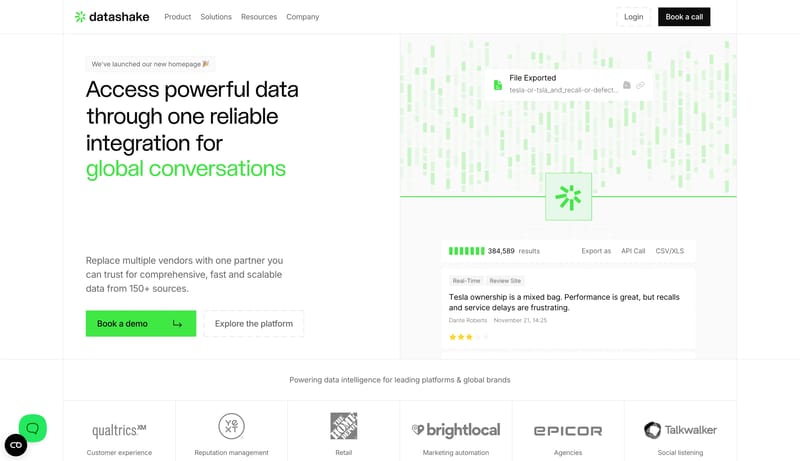
This design language turns data infrastructure into a crisp commercial interface. It uses white space, large editorial sans headlines, dashed utility borders, structured data cards, black commitment CTAs, and green live-action signals.

Access 150+ social & review sources through one API. Get real-time + 5 years historical data with 98.3% uptime. Trusted by enterprise platforms.
Design Analysis
This design language turns data infrastructure into a crisp commercial interface. It uses white space, large editorial sans headlines, dashed utility borders, structured data cards, black commitment CTAs, and green live-...
This design language turns data infrastructure into a crisp commercial interface. It uses white space, large editorial sans headlines, dashed utility borders, structured data cards, black commitment CTAs, and green live-action signals.
Use white as the primary page canvas and 0D0D0D for text, nav, key borders, and black CTAs. Use 3FE844 for the highest-priority action or live data signal. Use 2D62FF for links, selected product states, and active data categories. Use FAFAFA for nested data rows and D9D9D9 for grid lines and dashed fields.
Use a large editorial sans for hero and section headings, around 76px / 82px for top-level statements and 44px / 52px for sections. Use system sans for body copy, controls, labels, and forms. Use mono only when content looks like API metadata, sample payloads, or identifiers.
Lead with a large data promise and a direct CTA pair. Use grid cards for data products, sources, and metric proof. Form pages should use a split layout: large statement and supporting proof on the left, fields on the right. The grid should feel technical but not crowded. Each card needs enough whitespace for values and labels to scan quickly.